Principle 2
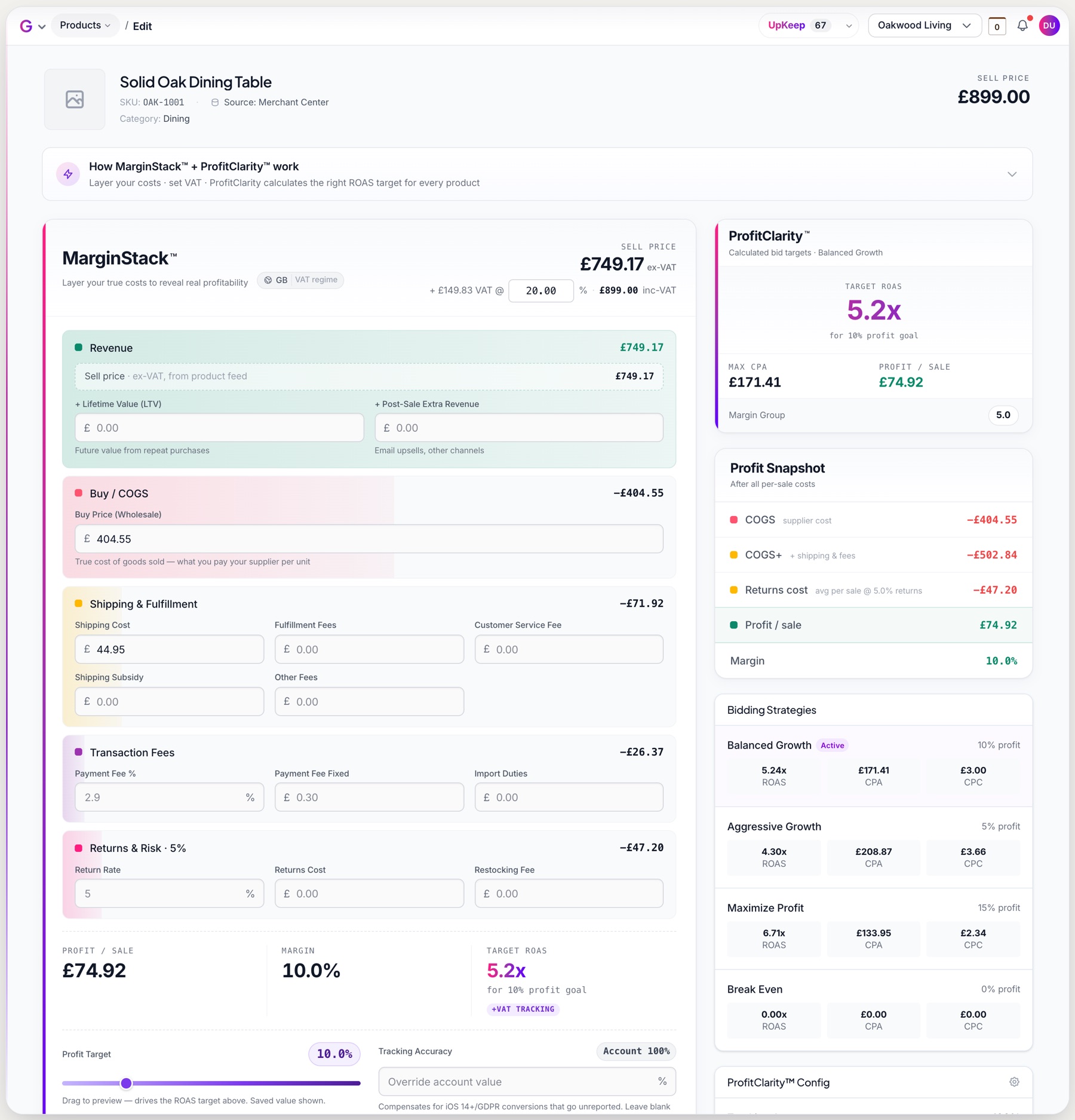
Now you understand that each product has a layer of costs associated with it when it sells, this is how we calculate your true margins.
Start with what the customer pays, then take off each cost in turn. What is left is the true margin: the most you could spend on advertising to win that sale and still break even.
The margin stack
Revenue
- Selling price
- What the customer pays for the product. Work from the price without VAT or sales tax, because the tax is never yours to keep.
- VAT / tax
- The tax included in the selling price, e.g. 20% in the UK. A £60 price with 20% VAT is £50 to you.
- Lifetime value (LTV)
- Extra value a new customer brings through repeat purchases. Covered in the next lesson.
Product cost
- Purchase price
- What you pay your supplier, or what it costs you to produce one unit. Your COGS.
- Import duties
- Duty paid per unit, if it is not already included in your purchase price.
Shipping & fulfilment
- Shipping costs
- What delivery costs you. If the customer pays for delivery in full, it cancels out. If you charge less than it costs, the difference is your shipping subsidy.
- Shipping subsidy
- The part of delivery you pay for on each order.
- Handling fees
- Picking, packing and preparing each order.
- Customer service fees
- The support cost you spread across each order.
- Other fees
- Your levy for wider running costs, like agency or operational fees.
Transaction fees
- Payment processing fees
- A percentage of the order value plus a fixed fee per transaction.
- Platform fees
- If you sell through a platform that takes a percentage of each order, include it here.
Returns
- Returns rate
- The percentage of orders sent back. On those orders you lose the sale, the fees you paid and the advertising that won it.
- Restocking fees
- Return shipping and handling for each returned order.
You don’t need every one of these on day one. Some cost tracking is better than no cost tracking, and every cost you add makes your bids more accurate.